


Top Stories
Mayors Innovation Project released a landmark report on women’s leadership

In the fall, Mayors Innovation Project (MIP) released Under Pressure, a national report examining how gender shapes the experience of serving as a mayor in the United States. The report grew directly out of years of engagement with women mayors, where patterns of differential treatment became visible despite little historical data documenting this experience. Drawing on surveys and in-depth interviews, the report finds that women experience higher levels of harassment, heightened scrutiny of competence, and persistent structural barriers to authority. These pressures create a double bind that drains time, energy, and personal well-being, while discouraging women from seeking or staying in office.
The report pairs these findings with concrete recommendations, making clear that systemic change is essential to strengthening local democracy and ensuring communities benefit from the full range of capable leadership.
MIP convened mayors to meet the moment

MIP hosted two national in-person meetings this year, creating a trusted space for candid peer exchange on the most pressing challenges facing cities through its Winter and Summer Meetings. These convenings allowed mayors to test ideas, share real-time problem solving, and learn from peers facing similar political, fiscal, and community pressures.
The Winter Meeting in Washington, DC focused on advancing local wealth, welcoming and inclusive communities, flood resilience, and governance culture, with insights from national experts and fellow mayors.
The Summer Meeting in Albuquerque, NM marked MIP’s first gathering in the Southwest and explored mayor-led approaches to public safety, public rights, heat resilience, and homelessness, reinforcing the power of connection and shared learning across cities.
New cohorts supported city leaders on street safety and small business growth
Building on insights from prior cohorts and ongoing mayor engagement, MIP expanded its cohort-based work to address pedestrian safety and economic opportunity. Welcoming its third cohort of the Mayors Institute on Pedestrian Safety, MIP brought together twelve mayors from across the country to confront the ongoing rise in pedestrian fatalities and advance safe and accessible streets. Peer learning and expert support helped mayors rethink street design, improve data-driven decision-making, and better protect vulnerable residents.
In fall 2025, MIP launched the inaugural Regulatory Justice Initiative in partnership with Cities Work at the Institute for Justice. This cohort is supporting 6 mayors and cities through June 2026 in removing outdated regulatory barriers and advancing policies to make it simpler, cheaper, and faster to start a small business.


State Smart Transportation Initiative released Innovative DOT for transportation leaders
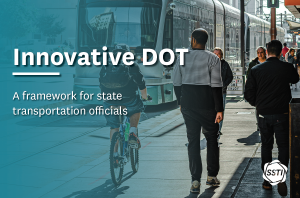 This year, the State Smart Transportation Initiative (SSTI) unveiled its latest Innovative DOT, a bold new framework to help state transportation agencies as they face unprecedented expectations and constraints. Drawing on more than a decade of original research and close collaboration with state DOTs, it offers concrete strategies focused on what agencies can actually control: how they plan, deliver projects, run their systems, and support their people.
Innovative DOT grew out of SSTI’s role as a trusted partner to state DOTs, helping agencies navigate complex challenges where policy, practice, and politics intersect. The result is a flexible, clearly organized roadmap that helps agencies move beyond business-as-usual and make measurable progress toward systems that better serve communities and support long-term prosperity.
What SSTI readers paid attention to
In 2025, SSTI published more than 25 original posts covering the latest transportation trends, emerging research, and state-led policy shifts across the country. These updates, featured in our biweekly newsletter, continued to be a go-to resource for policymakers looking to understand where transportation policy is headed and what’s working on the ground. This year, readers gravitated toward stories that highlighted state-led innovation. Below were three of our most popular blogs from the year.

Washington became the first state to authorize shared streets, giving people walking and biking priority, slowing vehicle speeds, and removing jaywalking restrictions. The new law opens the door for safer, people-centered street design and could serve as a model for states across the country.

California will let agencies pay for housing to offset increased driving
A new California law allows transportation agencies to fund affordable housing as a way to mitigate increased driving from major road projects. The approach links transportation, climate, and housing goals while offering a new tool to reduce vehicle miles traveled.

Connecticut DOT secures deal to limit project delays after years of collaboration
Connecticut DOT reached a first-of-its-kind agreement with federal agencies allowing the state to conduct its own historic preservation reviews, reducing delays for rail and transit projects. Built through years of coordination and added in-house expertise, the deal is expected to speed delivery, cut costs, and serve as a model for states seeking to streamline project approvals without weakening protections.
Federal Anti-Worker Policies Threaten Working Wisconsin
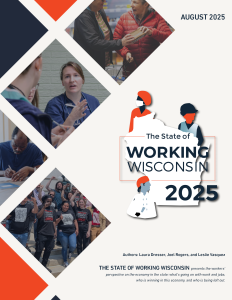 For nearly 30 years, our State of Working Wisconsin has provided a worker’s perspective on the economy and how Wisconsin workers are faring. The 2025 report arrived at a critical moment, documenting record-high wages and employment alongside persistent inequalities, slow job growth, and declining union coverage. This year’s report also highlighted the vital contributions of immigrant workers and provided an overview of how chaotic and anti-worker federal policies threaten workers’ opportunities.
We believe that this basic understanding of reliable and timely data is essential to building an economy that works for all working Wisconsinites. Our outreach included an op-ed, multiple interviews in statewide media sources, and presentations to community groups and unions. In this work, we seek to increase economic literacy and provide the people of the state a resource to understand the economic challenges workers are facing, to measure progress, and take steps to ensure more broadly shared prosperity.
SSTI kept sustainability front and center
As the federal transportation landscape shifted in 2025, state transportation leaders faced uncertainty around climate, safety, and multimodal priorities. In response, SSTI expanded its Sustainability Network to offer DOT staff a consistent space for peer learning, problem solving, and shared strategy. Meeting once or twice a month, participants connected with national experts and each other to navigate a fast-changing federal environment, identify ways to do more with limited resources, and keep critical projects moving forward.
Through the Network, members engaged in facilitated exercises on project prioritization, communications, and resilience, formed a working group to advance emissions analysis and tools, and built relationships through informal meetups at major conferences. As sustainability and active transportation efforts faced new headwinds, the Network helped state leaders stay connected and focused on delivering transportation systems that meet community needs.
Pedestrian Safety Cohort wins in action
Across current and past MIP cohorts, city leaders are turning shared learning into real-world impact. These examples showcase recent wins from current and past cohort members across the country.
Kansas City, MO
2024 Alumni
In November 2025, Kansas City passed Mayor Quinton Lucas’s traffic safety ordinance prohibiting right turns on red when school zone speed limits are in effect. Allowing right turns on red lights forces drivers into crosswalks and makes streets more dangerous for people walking and biking. This ordinance is one of several changes Kansas City is making to make streets safer for pedestrians.
Lansing, MI
2025 Alumni
This summer, Lansing broke ground on pedestrian refuge islands at a busy intersection. Pedestrian refuge islands are raised curbs that allow pedestrians a safe place to pause as they cross the street. The intersection Lansing is targeting was the site of 12 crashes involving pedestrians over the course of just four years.
Lima, OH
2025 Alumni
During the Summer of 2025, the City of Lima, OH installed new accessible pedestrian signals to make crosswalks more accessible for visually impaired people. The new signals use an audible tone to let pedestrians know whether it is safe to cross the street or when to wait.
ProGov21 deepened its policy guidance for local governments
ProGov21 also continued to expand its searchable library of progressive local policy solutions, offering cities practical guidance on policy design and communication.
The platform grew to include more than 2,000 policy and practice resources, increased automation of new material scanning, and expanded its policy roadmaps to cover 22 issue areas. These roadmaps explain the problems policies address, current approaches, and pathways for strengthening local action.
GPAL strengthened access to local performance insights
GPAL (Government Performance Action Lab) is a joint project of the High Road Strategy Center and Polco, in partnership with Stanford’s Hoover Institution. It is a web-based platform enabling any community in America, in real time and using the latest data from more than 300 trusted longitudinal datasets, to see how it is performing relative to others across 11 core measures of community livability and performance, including safety, economy, education and culture, health and wellness, mobility, housing and community design, natural environment, parks and recreation, utilities, community connection, and fiscal health. In 2025, alongside regular data updates, GPAL introduced a new fiscal health measure and expanded tools allowing communities to use its secure AI agent, “Polly.”
Recent Words From Our Allies


Don’t miss out on any of our highlights – follow High Road Strategy Center on Facebook, Instagram, LinkedIn, Twitter (X), and subscribe to our newsletter.