

This is an accordion element with a series of buttons that open and close related content panels.
Higher Minimum Wages for Working Wisconsin
Since 2009, Wisconsin’s minimum wage has been stuck at the federal minimum level of $7.25. Every year, inflation eats away at its value, reducing the purchasing power by 30% since 2009. If the state’s minimum wage had just kept pace with inflation, it would be $10.60 this year.
At $7.25, a Wisconsin minimum wage worker with full-time employment would earn just under $15,000 for a year’s work, leaving the worker in poverty. Wisconsin’s paltry minimum wage standard has no credibility as a living wage. High profits posted by firms with many low-wage workers add insult to injury.
Though Wisconsin has failed to raise the wage floor, raising the minimum wage is popular with voters across the nation and across the political spectrum. Currently, 30 states – including all of Wisconsin’s neighbors except Iowa – have raised their minimum wages above the federal floor. The popular support of minimum wage increases is clear in conservative states where higher minimum wages win on the ballot. In 2024, voters in Alaska and Missouri raised their minimum wages to $15 per hour. Despite strong popular support for higher wages, Wisconsin’s lowest wage workers are still being left behind by state policymakers.
Wisconsin’s low wage floor is clear in Figure 1, which provides current minimum wages for all states surrounding Wisconsin. The current minimum wage is $15.00 in Illinois, $13.73 in Michigan, and $11.41 in Minnesota. Of the states on our borders, we share the low minimum wage standard of $7.25 with only Iowa. But even in Iowa, workers who are tipped do better than in Wisconsin. At just $2.33 per hour, Wisconsin has the lowest tipped wage in the region. Because of Wisconsin’s failure to raise the wage floor, the state’s low-wage workers are falling behind.

Strong Labor Standards Support a Strong Economy
A strong and well-enforced minimum wage provides the foundation for standards in labor markets. Unfortunately, in recent years, some Wisconsin policymakers have been more interested in reducing and weakening labor standards. In recent years, Wisconsin has weakened child labor protections and reduced workers’ access to Wisconsin’s Unemployment Insurance system.
Strong and enforced labor standards are especially important to level the playing field between employers. Many businesses are already paying higher wages, but some employers are on the low-road, ignoring or avoiding labor regulations and violating workers’ rights. These employers may misrepresent schedules, chronically undercount hours of work, or commit other forms of wage theft (denying payment for hours worked), or misclassify workers as “independent contractors,” thus exempting them from the right to the hourly minimum at all. Raising and enforcing the wage floor signals to all – employers and workers alike – that work is valued and that standards for employment will be upheld by the state.
A higher and well-enforced minimum wage helps build a floor that allows workers, employers, and our communities to thrive. In this report, we offer a picture of who wins in Wisconsin with higher minimum wages and some reasons to support higher labor standards for the state. We seek to reduce confusion and expose myths that have held back the minimum wage for too long. Stronger labor wage floors directly help workers who see raises, and they also reduce inequality and strengthen our communities.
$20 Minimum by 2030
In this report, we rely on analyses from the Economic Policy Institute (EPI) to estimate the impact of raising the wage to $20 per hour in a series of steps from now to 2030. The structure of this increase is similar to current minimum wage proposals in the state. More importantly, this approach to minimum wage increases – nearly tripling the wage floor over a four-year period – is directly aligned with recent research again from EPI. That research argues for setting the federal minimum wage at two-thirds of the median wage, or $20 by 2030, pointing out:
Decades of economic research support this two-thirds benchmark, finding little to no employment loss from ambitious minimum wage increases.
The report also notes that raising the minimum wage to $20 by 2030 helps move our minimum wage more meaningfully toward a living wage and helps reduce economic inequality.
Low minimum wages are not working for working people in Wisconsin. The demand for $15 was made by workers in 2012, long before the pandemic shutdowns, before the increasing understanding of the “essential” nature of these jobs, and before the dramatic inflation of 2022. To move our floor to a standard that workers can actually afford a decent life requires consideration of $20 per hour. Workers can’t survive on $7.25.
Raising the Minimum Wage to $20 by 2030 Would Reach Hundreds of Thousands of Wisconsin Workers
Throughout this report, we provide information on the workers who gain with a minimum wage increase to $20 per hour by 2030. Figure 2 shows just how many Wisconsin workers would win with a higher wage floor. Overall, more than one of every four workers would see some increase in their wages (27% of workers; more than 730,000 people) if the state’s minimum wage rose to $20 by 2030.
Wisconsin’s 730,000 workers with wage increases includes two groups: those who are directly affected by the increase and those who are indirectly affected. Workers are directly affected when their current wage is lower than the new proposed minimum of $20 per hour. The state has some 458,800 workers who would see direct wage increases with a $20 minimum wage. Workers are indirectly affected when they earn just above the new proposed minimum; these workers get raises as pay scales adjust upwards. These indirect wage increases would raise wages for another 277,700 workers in the state.

Who Stands to Gain? Raising the Floor Helps Close Racial and Ethnic Wage Gaps
We can take a closer look at both the demographics and industries of workers who would get a boost with a higher minimum. These are both important explorations because opportunity and wages are not evenly distributed by demographics or industry. Wisconsin’s labor market shows deep disparity. Wages are higher for white men and lower for white women and for Black and Brown men and women. Increasing the minimum wage disproportionately increases wages at the bottom of the labor market and can close those gaps. Further, the state’s lowest wage jobs are concentrated in specific industries. Increasing the minimum wage brings workers in those industries closer to the median as well.
In this section, we consider all workers affected by the minimum wage increases (which combines the directly and indirectly affected workers).
Figure 3 shows that increasing the minimum wage is much more meaningful to specific groups of workers. Women are much more likely than men to see wages rise. One-third (33%) of women see wages go up, compared to 21% of men. Nearly half of workers identifying as Black or Hispanic would see wages increase. That’s twice the share getting raises compared to white workers. Additionally, nearly 154,000 workers living in poverty would get a raise.
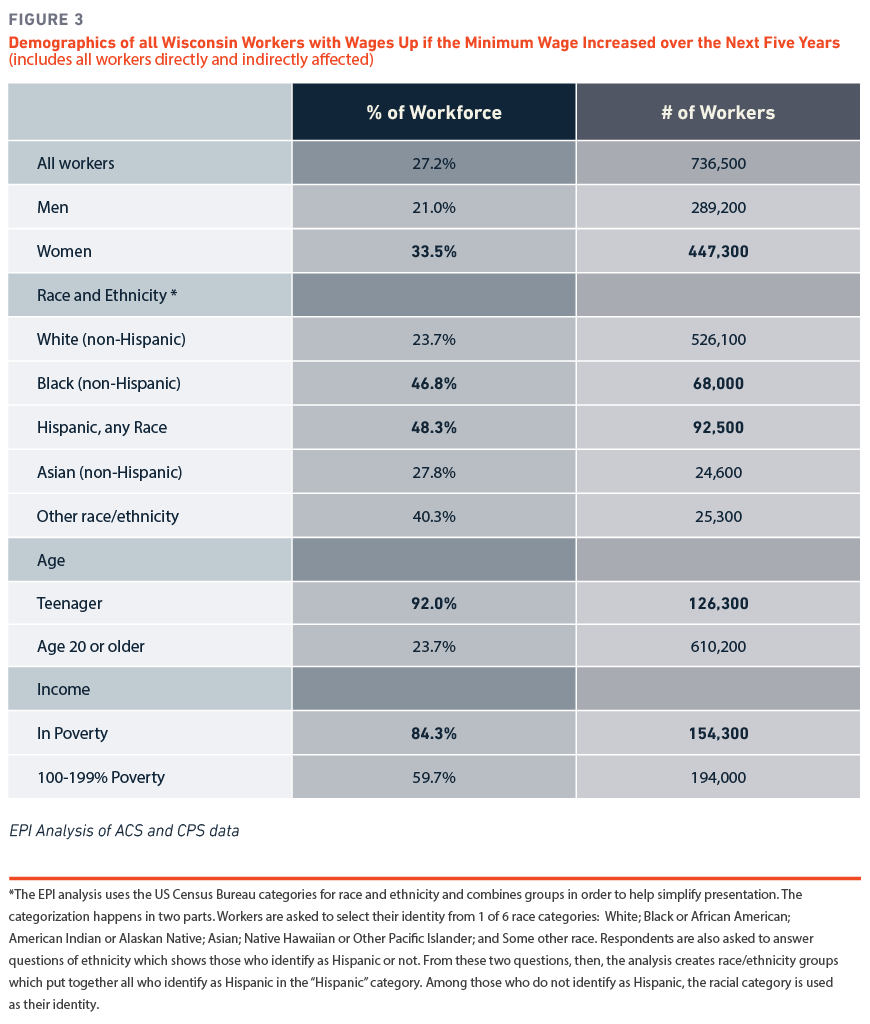 Figure 3 also shows how important raising the minimum wage is for teenage workers. Raising the minimum wage to $20 would raise the wage of 92% of teenage workers – more than 126,000 teenage workers would see wages go up. Recent research on increasing minimum wages in California shows that as wages go up for teenagers, they work less and have more time to devote to schooling. And while it is true that most teenagers would see raises, equally important, nearly three out of four of the workers who would see raises are 20 years old or more.
More than 80% of Wisconsin families living in poverty would see their incomes go up with an increase in the state minimum wage to $20. And nearly 60% of families near poverty (with income between 100-199% of the federal poverty line) would also get a boost from the wage increase.
Raising the Minimum Wage Helps Service Sector Workers
Figure 4 provides information by industry. The table includes all industries and is arranged according to the number of workers who see a wage increase, with the industry with the largest number at the top. Nearly 40% of all Wisconsin workers who win with a $20 minimum wage are employed in just two sectors: Retail and Restaurants. The wage increase would bring higher wages to nearly half of retail workers in the state and raise wages for some 152,000 workers. Wage increases would reach most restaurant workers with earnings up for 4 of every 5 restaurant workers, accounting for another 134,000 workers who see wages rise.
Another two sectors stand out not because they have particularly low wages, but because they are so large that even with low shares of workers who would see raises, the total numbers of workers are considerable. The Health Care sector provides higher wages than restaurants and retail – 27% of workers would see wages go up as a result of the $20 minimum wage. Given the sector’s large size, the wage increase would reach 114,400 health care workers. Manufacturing is another example of a sector with relatively high wages – just 15% of workers would see wages go up with an increase to $20. But Wisconsin’s manufacturing sector is so large, 80,000 workers would see raises.
There are a few other sectors that stand out for the share of the workforce that would see raises in Wisconsin. In each of these sectors, nearly half or more of workers would see wages go up with an increase to $20. This ranges from 61% in accommodation, 53% in arts, entertainment and recreation services; to 47% in agriculture, forestry, fishing, and mining. We’ve included all industries in Figure 4 which shows the sectors where very few workers would see changes in wages as a result of an increased minimum wage. (Note, for example, the construction sector where just 11% of workers would see an increase.)

Eliminating the Tipped Minimum Wage Would Bring Relief to Wisconsin’s Tipped Workers
In Wisconsin, the minimum wage for tipped workers is just $2.33 per hour. This is the cash wage that the employer of a tipped worker must pay. (Workers have the right to earn the minimum of $7.25 considering both the cash wage and tips.) In all neighboring states, tipped workers have a higher minimum wage. Tipped minimum wages range from $4.35 in Iowa and $5.49 in Michigan to $9.00 in Illinois. Minnesota has eliminated the tipped minimum wage. A tipped worker there earns at least the minimum wage of $11.41 per hour and takes home tips too. A higher tipped minimum wage increases the income of tipped workers and provides workers with more predictable income.
Like Minnesota, Wisconsin could eliminate the tipped minimum wage and establish one wage floor for all workers. Figure 5 shows the reach of such a policy because it models one wage floor for Wisconsin. All of the state’s 52,700 tipped workers would see raises if the tipped minimum was eliminated as it has been in Minnesota.

Gains from Raising the Minimum Wage
With a minimum wage of just $7.25 per hour, low-wage workers in Wisconsin are being left behind. In 30 states and the District of Columbia, the wage floor is above our state’s meager $7.25. Twenty states index their minimum wage to inflation so that workers can keep up with rising prices. All this innovation in minimum wages allows for greater analysis of the impact of increases.
A 2024 paper reviewed 88 studies of minimum wage increases. The authors found a modest impact of minimum wage increases on employment. In studies of minimum wage increases since 2010, the impact on jobs was zero. In an interview, Michael Reich, at UC Berkeley’s Center on Wage and Employment Dynamics, summarized his research on minimum wage increases in California this way:
A minimum wage increase doesn’t kill jobs. It kills job vacancies, not jobs. The higher wage makes it easier to recruit workers and retain them. Turnover rates go down. Other research shows that those workers are likely to be a little more productive, as well.
The research he is referring to analyzes the impact of minimum wage increases across California with special attention to employment at small businesses (such as restaurants, small grocery stores and retail outlets). The work shows no impact on jobs, and some small impact on consumer prices.
An analysis of state differences in minimum wages also finds strong job growth in states with higher minimum wages. Researchers at the Center for American Progress found that states with minimum wages higher than $12 per hour saw 25 percent employment growth in the Leisure and Hospitality industry in 2021 compared to only 7 percent in states with the federal minimum wage of $7.25 per hour.
Research also shows that states that eliminated tipped minimum wages had faster growth in their leisure and hospitality industries than those that did not.
Raising the floor under wages for Wisconsin would provide stability and predictability for workers who have made gains over the last three years. As we have demonstrated in The State of Working Wisconsin, low-wage workers have made the strongest gains in recent years. Raising the wage floor would support and sustain these gains. When first demanded by workers in 2012, the Fight for $15 was often dismissed by policymakers and economists. But workers knew they couldn’t survive in jobs with low wages, volatile and insufficient hours, and no paid time off. Their demands are changing pay in low-wage jobs.
A strong, statewide wage floor secures the foundation for labor market standards. Many who work at or near the wage floor face issues such as wage theft, unfair scheduling, and other violations of basic workplace standards. In addition, many of these workers are Black, Brown, immigrants, and/or undocumented. Like their peers across the state, these workers are taking matters into their own hands and taking action to improve their job quality. A higher minimum wage strengthens the floor especially for these workers, and is a further step towards improving job quality in this state, especially for Black and Brown workers.
At the federal level, the Raise the Wage Act has just been introduced and would raise the national minimum wage to $17 per hour by 2028. An analysis of this act points out, “Increased wages would make a tremendous difference in the life of a cashier, home health aide, or fast-food worker getting paid the minimum wage. These workers today often struggle to cover the basics, like food and rent, on less than $35,000 a year.”
These are the very same workers in the state of Wisconsin who can’t survive on $7.25.
Data Source: EPI Minimum Wage Simulation Model
In this report, we present the analyses from our partners at the Economic Policy Institute (EPI), in Washington, DC. EPI is a leading national resource on the economics of key labor policies including minimum wages. For the information reported here, we show results of their minimum wage model utilizing American Community Survey (ACS) and Current Population Survey (CPS) data, focusing on raising the wage in Wisconsin to $20 by 2030. For details on methodology, refer to this.
Acknowledgments
Can’t Survive on $7:25: 2026 Update was written by Laura Dresser, Associate Director of the High Road Strategy Center at the University of Wisconsin–Madison. We want to thank the Economic Policy Institute (EPI) for the data used throughout this report. Report layout and visual design were completed by Leslie Vasquez.